
A family in a small village — Bakas, Bali.
As we strolled through the countryside of Bakas in Bali, magnificent temple-like buildings repeatedly appeared before our eyes.
Until we asked the locals, we assumed they were some kind of special facility. Seeing these grand structures every time we walked through the village, we felt the profound depth of the local culture. However, when it was explained that they are family temples called Sanggah, and that most homes have one, we couldn't help but gasp in surprise.


It was Ari and Shindi who explained this to us.
Even though we had just met, they warmly invited us into their home and taught us about Balinese customs and events. They also shared that a ceremony called Telu Bulanan would soon take place at their home for their daughter, who was reaching 3 months of age—exactly 105 days.


Having learned a little more about Bali, the scenery reflected in my eyes gained a deeper, richer hue.
Though not a coconut plantation, coconuts are abundant; domesticated birds roam freely, and rice paddies spread out as if agriculture itself designs the landscape. Experiencing the gentle demeanor of the people living in Bakas—a village where Bali's nature and culture breathe—made me hope that the beauty of this land will be passed down forever.


Looking up at the sky as the sun leaned toward the horizon, I saw a kite soaring. It was remarkably high—higher than any building in Bali. In the evening light, it looked like a single thin thread stretching from the village to the sky. Watching the neighborhood children enjoy flying kites, I asked about the height and was told the string was 100 meters long.
Much like the beautiful terraced rice fields, landscapes shaped by human daily life hold a power to soothe the soul.
I gazed at the patterns in the sky, as if immersed in childhood memories.


The next day, we had Ari and Shindi wear our Kimono-fuku for a photoshoot.
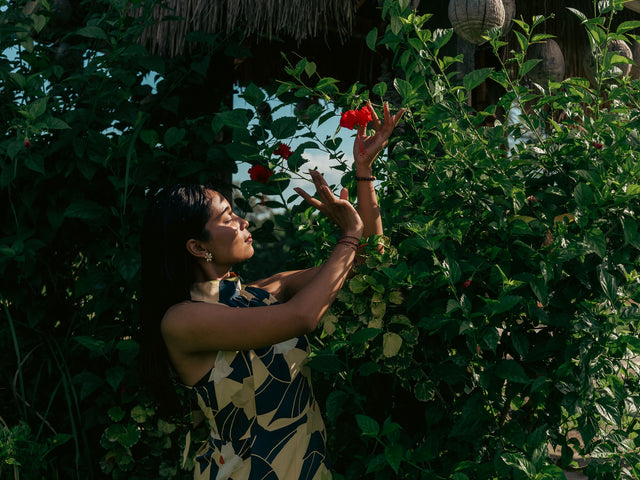
As the sunlight began to slant, Phalaenopsis orchids bloomed, glowing amidst the greenery. I once worked at a flower shop, but this was the first time I truly felt the beauty of these orchids. The orchids, a motif often seen on kimonos, became translucent under the strong light, taking on a distinct purple hue.
Beside them, Shindi wore a dress featuring camellias on a navy background. The texture of the crepe (chirimen) fabric truly came alive in this light.


Ari wore a shirt in a pale young-leaf green. Its expression seemed to shift depending on how the light hit it, likely due to the fabric's three-dimensional weave. It blended naturally into the surroundings, yet maintained a subtly different tone.
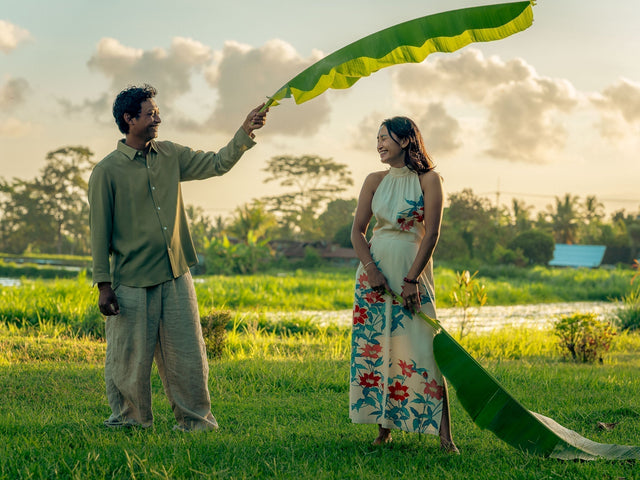
Shindi in a Yamayuri dress with red flowers blooming on a white background, standing with a large banana leaf. As the evening sun filtered through, her silhouette was cast upon the leaf. That shadow reminded me of Wayang Kulit.
The shadows cast on the ground and walls, created by the sun, trees, and architecture, are among the most striking scenes in Bali. This is perhaps because the brilliant sun shines unhindered, and with many buildings lower than the coconut trees, the evening light is left unobstructed.
I briefly thought that perhaps shadow plays are a deeply familiar medium in this land for that very reason.


I also love the faint light born from the setting sun. Around that time, I frequently saw people burning incense or organic matter. That atmosphere gives the surroundings a slightly ethereal feel.
Shindi wears a brown Haori dress inspired by the kimono. And Ari is clad in a linen shirt upcycled from a kimono.
The subtle light of this hour, the depth of the garments, and the texture of her skin harmonized beautifully. The summer pongee (Natsu-tsumugi) fabric has a crisp feel that effortlessly suits the climate of a Balinese dusk.
Because Japanese summers are also humid and hot, summer fabrics are designed to feel comfortable against bare skin. They, too, were moved by this texture and shared joyous words with us.
Feeling a sense of comfort in their presence, I released the shutter.


A few days later, dressed in formal Balinese attire, we attended their daughter's Telu Bulanan.
The ceremony was held amidst a warm family atmosphere.
During my stay in Bali, I participated in three different ceremonies. What they all had in common was that, despite the prayers offered by a high priest (Sulinggih), there was a peaceful atmosphere, and everyone participated naturally. Perhaps "living traditions" is the fitting term. A joy in sharing was present there.
It also left an impression on me that the family wore traditional formal attire coordinated with the exact same fabric.


In the area around Bakas, there are almost no tall buildings, and the village spreads out gently without being overly dense. Even riding a motorbike down the road, there is little sense of being enclosed by walls or buildings; the sky, the greenery, and the signs of human life seem to continue while maintaining a comfortable distance.

Bali is a famous island visited by people from all over the world. There are many tourist areas, and I imagine the people living there know how their island is viewed from the outside.
Even so, the time spent in Bakas held a tranquility of life itself, entirely distinct from things curated for tourism. The people's presence on that land did not look as though they were forced to stay by custom, nor did it seem they merely lived spaciously because they were in the countryside with ample land.

Rather, it reflected people choosing to live there while cherishing the distance between the land, family, customs, and nature. Knowing the outside world, yet never letting go of the richness found in daily life. Looking back at the photos after the journey, I felt that quiet strength lingering in Bakas's open skies, its green paths, and the gazes of the people standing there.

*In Bali, a rite of passage called "Telu Bulanan" is held 105 days after birth. In the Balinese Hindu worldview, a newborn is believed to still hold strong ties to ancestors and the sacred realm. This ceremony marks an important milestone when the child touches the earth for the first time and is welcomed into the human world.
**The traditional shadow puppetry known as "Wayang Kulit" continues to be passed down. This performing art, which narrates myths and epics like the Ramayana and Mahabharata through shadows cast by lamplight, is not mere entertainment but one of the symbols of Bali's spiritual culture, deeply intertwined with temple festivals and life rituals.
0 Comments
There are no comments for this article. Be the first one to leave a message!