
Laklak and the Flowers of Bali — Aan, Bali.
At the Semarapura market, where we stopped by in the early afternoon, the scent of Laklak drifted through the air. I had tasted it for the first time only that morning and had immediately taken a liking to its gentle sweetness and texture.
Among the many stalls, we were somehow drawn to one selling Laklak and joined the line. While we waited, we were invited to try making some ourselves. Batter made from rice flour, coconut milk, pandan leaves, and other ingredients was poured into small hemispherical molds, something like a takoyaki pan, heated over firewood.
As we waited, I found myself watching the stall for a while: the firewood, the stove, and the roof woven from coconut and other natural materials. Under the strong midday light of Bali, everything seemed to move at a slower pace, and even the waiting felt pleasant.


Freshly cooked Laklak was arranged on plates woven from banana leaves, then finished with coconut meat and brown sugar syrup, adding richness to its flavor. The stall was busy with people who had come for that taste.
Even so, Dila, the owner of the stall, began talking with us. The Laklak itself was delicious, of course, but I was equally interested in the way it was prepared and served, and our conversation naturally grew from there.
He told us many things. He was a traditional dancer, involved in environmental conservation and in activities that nurtured the local community. When he told us that both his son and daughter were also traditional dancers, something clicked in my mind: the presence of the young woman who had been standing at the Laklak stall, showing us around.
A conversation with someone encountered in a place we had never been before. And yet, beneath it, there was a sense of connection that we both seemed to recognize.
Dila, together with his daughter Puspa, who had been listening alongside us, kindly agreed to take part in a photoshoot wearing our garments.

Two days later, we were at the Laklak warung at Aan Secret Waterfall.
Related story: “The Hidden Waterfall and Dila - Aan, Bali.”
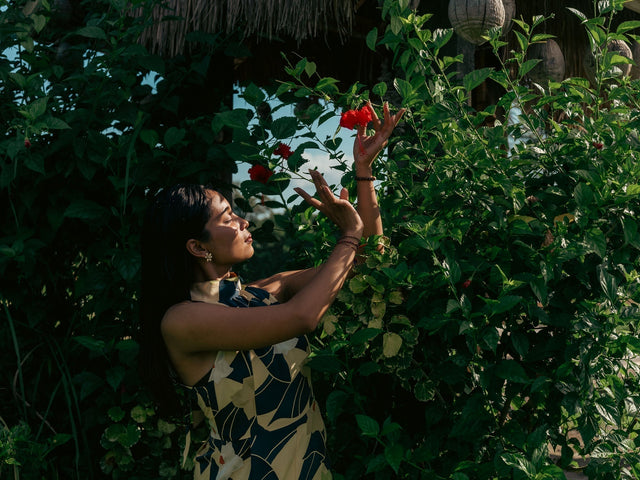
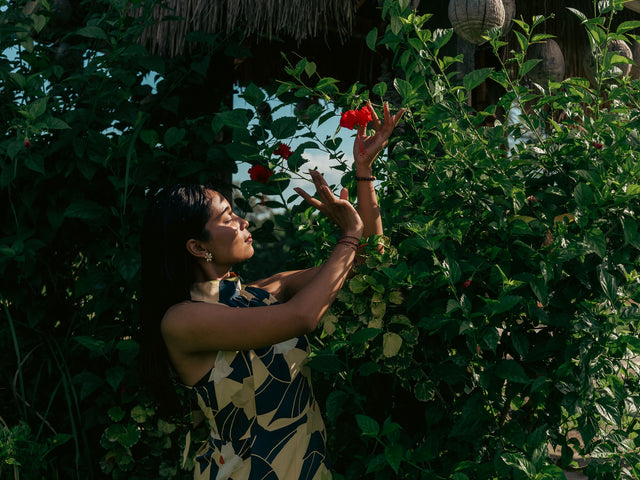
Dense green foliage, thin clouds fading into a summer sky. With a vivid hibiscus tucked behind her ear, Puspa wore a floral dress with a distinctly resort-like presence.
Had the artisan who dyed and painted this kimono ever seen the nature of the tropics? The colors and strong contrasts seemed so at home in the Balinese landscape that the question came naturally. Beside the vivid greens under the sun and the flowers blooming among them, the plants drawn across the cloth almost appeared to belong to this place.


The lines of her body as a dancer worked naturally with the silhouette of the Yamayuri Dress. It was dressy, yet never felt out of place in the tropical air. Watching the hem move in the breeze and the fabric shift with her body, I began to feel that the inherent richness of kimono cloth was never meant only for formal or exceptional places.

Balanced on Puspa’s head was a “sokan,” something we had often seen in everyday Balinese life. People carried things on their heads as they walked, and for her it seemed entirely natural. Keeping it in place, she straightened her posture and showed us a pose from traditional dance.
It is difficult to find an exact equivalent in Japanese life. Perhaps it is something like the way people once tied a furoshiki without thinking, or naturally handled the hem of a kimono. There is a particular beauty in gestures learned through repetition and embedded in the body, different from movements consciously performed to appear beautiful. Culture does not remain only in visible things such as buildings, costumes, and festivals. I think it also lives within these small gestures.


The halter-neck gathered dress works naturally even with a barefoot styling that lets the soles of the feet meet the earth. Large peonies bloom across a yellow ground, while generous gathers, using almost an entire kimono, create a full flared silhouette. Puspa added a vivid hibiscus at her ear, echoing the colors of the cloth.
A flower drawn on fabric, and a flower freshly picked.
There was something strangely natural about seeing the two together on the same body.


One of the things that continually surprised me while walking through Bali was the environment surrounding each home. For me, the word “home” had always first meant a building. Here, however, the garden, plants, stones, water, and places of prayer all seemed to belong together, forming a single space for living.
Puspa’s home was the same.


Plants grow, flowers bloom, and time leaves its marks on the surfaces of stone and wood. People live there, family members come and go, and daily life continues to accumulate. Nothing feels excessively decorated, and yet almost every view seems somehow beautiful.
At her home, we photographed a dress made from brown kimono cloth patterned with sarasa motifs.
Throughout this journey, I repeatedly found myself wondering why so many plants and flowers have been depicted on kimono.
People have long lived close to nature, observing it and finding beauty in its forms and in the changing seasons. Perhaps because we cannot wear nature itself, we have traced the shapes of flowers, turned the movements of leaves into lines, and placed their colors onto cloth.
Sometimes they are rendered realistically; at other times, they are boldly simplified and transformed into geometric patterns. More than merely copying plants, these designs seem to reveal the ways in which people have looked at nature.


Standing among the plants of Bali and looking again at kimono cloth made this feeling even clearer.
Although the cloth was born far away in Japan, when placed among stone, wood, green leaves, and strong sunlight, it somehow settled naturally into the landscape. Perhaps the sensibility of looking closely at nature and receiving shapes and colors from it is something that can travel beyond place.
As the sun began to angle across the horizon, the light slowly softened.
The surface of stone, old wood, plants growing in the garden, and the textures of chirimen and silk were all traced by the same light.
In a place where Puspa often practices dance, we asked her to move for us for a while.
The awareness extending to her fingertips. Her gaze. The slow transfer of weight.

As I pressed the shutter, I found myself thinking again that clothing does more than simply cover the body. When a person moves, the fabric moves with them, revealing lines that cannot be seen while still.
Even after taking a form different from the kimono it once was, the colors and patterns left within the cloth begin to move again on another body.
Our meeting had begun with an ordinary conversation while waiting for Laklak at the Semarapura market.


Two days later, we were beside the waterfall talking with Dila, while his daughter Puspa danced in the clothes we had brought.
Travel sometimes creates moments like this.
Nothing had been planned from the beginning. But through a shared curiosity about food, clothing, and the nature of a place, and through gradually exchanging words, a line begins to form between people who until then had no connection at all.

Rather than looking at a culture encountered in an unfamiliar land as something distant or exceptional, we begin to recognize within it a sensibility that also feels familiar to us.
Perhaps those were the moments I most wanted to leave behind in photographs from this journey.
0 Comments
There are no comments for this article. Be the first one to leave a message!