
A small village — Bakas, Bali.
Coconuts, bananas, and large leaves of unknown names. In this sun-drenched tropical land, the plants spread their branches and leaves freely, each at its own pace.

Bakas, a small village in Bali.
Stepping away from the well-known tourist areas, you find a quietly vibrant daily life. Dense greenery layers the roadsides, while in the moderately wide canals, people bathe or wash their clothes. Chickens, dogs, and cats wander about, and the sound of someone's voice drifts through the air. Bakas is a small village where, despite the intense sunlight, a profound sense of comfort prevails.
There, we met Yudi, a young man born and raised in this village.


When I asked him about the village, he smiled somewhat shyly and gladly shared his stories. He told me about the magnificent buildings often seen around, his favorite spots near the village, local customs, and how he spends his everyday life. As the sun slowly set, I desperately tried to memorize the unfamiliar words, sketching the outlines of the culture rooted in this land within my mind.
Through our conversations, it was decided that he would wear our Kimono-fuku for a photoshoot on a later day.

I occasionally pointed my camera at him as I listened to his stories.
Through the lens, he didn't appear as a subject detached from the scenery; rather, he looked perfectly in harmony with the local light and greenery.
In the middle of the shoot, his eyes casually caught the plants along the roadside, and he picked a soft vine growing nearby. Then, with an effortless gesture, he gathered his long hair and wrapped the vine around it, as if to adorn himself.
That simple gesture evoked the everyday life of the people in Bakas, Bali.


In Bali, I often saw flowers adorning the ears or heads of stone statues inside homes, or people wearing flowers in their hair during ceremonies. This gesture was entirely natural to him, yet wonderfully fresh to me. At the same time, it reminded me of my grandfather. My grandfather also used to pick vines from the road, tying things together to make them easier to carry. Not using intentionally manufactured materials, but simply picking up what is there to wear or use. This small act awakened a sensation I had long forgotten.

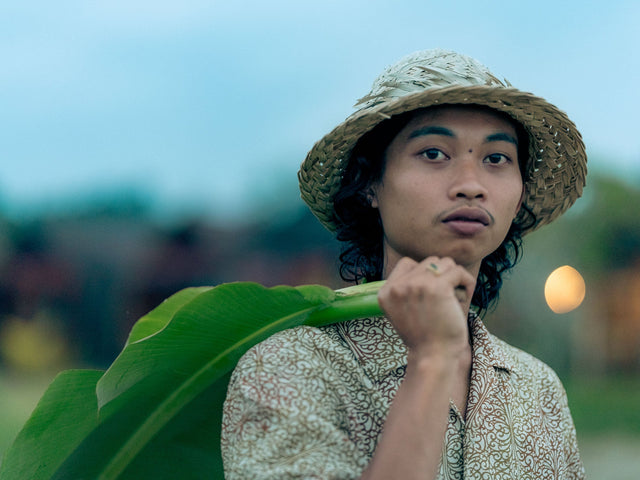
We had Yudi wear a Yue shirt featuring an all-over karakusa (arabesque) pattern. The ambiance of lush plants blended seamlessly with the Balinese air.
Many kimonos feature botanical patterns. This is something they share with Bali's Endek ikat textiles. And it’s not just beautiful flowers. There are many designs where plants are vividly alive or creatively stylized. Finding comfort in this sight—which felt both new and somehow familiar—I clicked the shutter.


A green vine rests quietly in his wavy hair.
I photographed him walking through his neighborhood, carrying a large banana leaf he found by the road. Not buying something special to decorate with, but simply living alongside what is already there. Banana leaves have incredibly diverse uses: wrapping food, serving as impromptu umbrellas, or acting as fans to keep flies away from the Babi Guling shared after a ceremony. While processing materials is one of humanity's great wisdoms, utilizing a raw material almost exactly as it is feels wonderfully refreshing.


Looking at that banana leaf, tied to such memories, I felt the richness of the land and the profound wealth of life flowing through rural Bali.
Immersed in an atmosphere where this sense of richness gently seeped into me, I was nothing but grateful to be able to shoot in a village so close to nature. Even in a foreign land, the "distance between people and nature" felt akin to that of our own country, hinting at a mysterious, deep-rooted connection.


I had wanted to see how clothes born from Japan's inherited kimono would look amidst the light and breeze of Bali. In reality, they blended in beautifully. He is not a professional model, but simply a young man living in Bakas. Here he was, wearing garments born and remade in Japan. And yet, the scene unfolding before me felt entirely natural to the eye.
His presence seemed to melt into the landscape, likely not because he was there as a model, but because he truly lived there.


Looking back at the photos after the journey ended, through Yudi's gaze, I felt I could truly understand the richness of a space where fields, rivers, skies, and people seamlessly intertwine.

0 Comments
There are no comments for this article. Be the first one to leave a message!